


The ANIMA network elects its new Board of Directors and Tarak Chérif is re-elected as President
Published on 07 December 2021
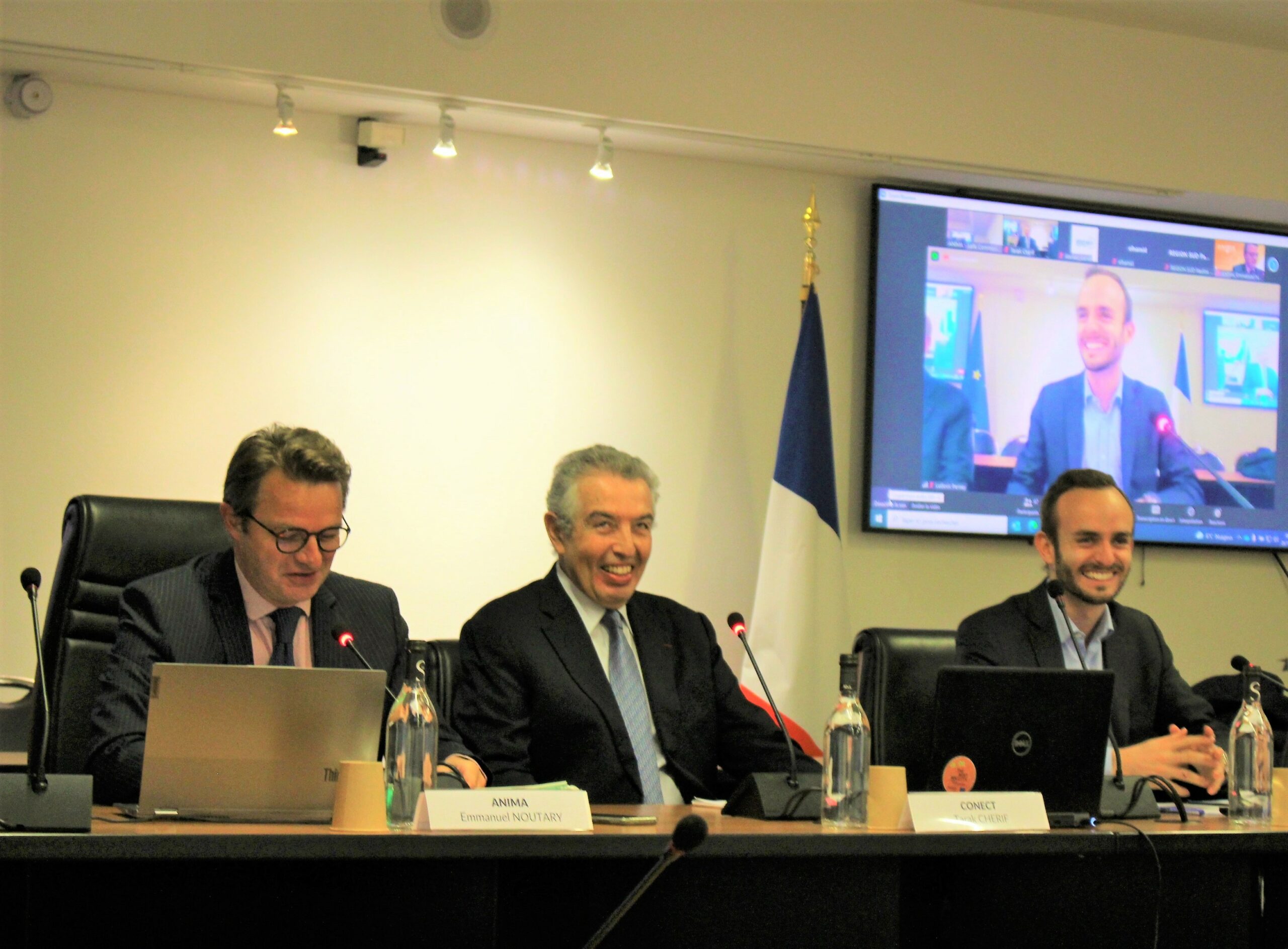
The network works on strategies for economic recovery in the Mediterranean.
Meeting on the occasion of their annual conference in Marseille on 25 and 26 November 2021, the members of the ANIMA network elected the members of their Board of Directors for the period 2022-2024 and reappointed Mr. Tarak Chérif, President of the Confederation of Citizen Enterprises of Tunisia (CONECT), as President of the network.
The new Board brings together 15 personalities representing organisations from 13 countries of the Euromed space. The conference was also an opportunity for the network to work on strategies for economic recovery in the Mediterranean with experts from UNCTAD, the Centre for Mediterranean Integration and the Femise network.
During two half-day meetings in Marseille, on 25 and 26 November 2021, the members of the ANIMA network held their General Assembly on Thursday 25 November afternoon to elect the members of the Board of Directors of their association for the 2022-2024 term. The new Board brings together 15 personalities representing organisations from 13 countries of the Euromed space.
The new directors then met to elect the association’s bureau. The composition of the new Board of Directors is as follows :
President
Mr. Tarak CHERIF, CONECT – Confederation of Citizen Enterprises of Tunisia, Tunisia
Treasurer
Mr Philippe YVERGNIAUX, Business France, France
Vice Presidents
Ms Vasso KYRKOU, Enterprise Greece, Greece
Mr Mohamed SHOAIB, GAFI – General Authority for Investment and Free Zones, Egypt
Ms Philo MELI, Malta Enterprise, Malta
Mr George CATINIS, SEBC – Syrian Enterprise and Business Center, Syria
Other Directors
Ms Yasmine SOUFIANI, AMDIE – Agence Marocaine de Développement de l’Investissement et de l’Exportation, Morocco
Mr Oscar PUIG, AMEC – Association of Industrial Exporting Companies, Spain
Mr Eric DE CLERCQ, AWEX – Agence wallonne à l’exportation et aux Investissements étrangers, Belgium
Mr Ramy BOUJAWDEH, Berytech Foundation, Lebanon
Mr Zied LAHBIB, FIPA – Foreign Investment Promotion Agency of Tunisia, Tunisia
Mr Ibrahim ABDALRAHIM, HCIE – Higher Council for Innovation & Excellence, Palestine
Mr Marios TANNOUSIS, Invest Cyprus, Cyprus
Mr Federico Maria BEGA, Promos, Italy
Mr Bernard KLEYNHOFF, Region SUD Provence-Alpes-Côte d’Azur, France
The ANIMA network also organised its annual conference on 26 November morning at the headquarters of the Provence Alpes Côte d’Azur Region, on the theme “Strategies for economic recovery in the Mediterranean”.
On this occasion, the members of the network were invited to discuss the theme with several international experts who came to share their analyses.
“We see that this crisis has accelerated several dynamics that were already at work for a decade: the new industrial revolution and digitalisation, the circular economy and the shortening of value chains, and more broadly the organisation of global production. It is necessary to understand the evolution of global demand as it will drive future investments. A network such as ANIMA is essential for us to be able to exchange ideas, between public and private actors, between countries, on the evolution of the economic and social situation, and on the responses to be provided” declared President Tarak Chérif in introducing the conference.
The participants had the opportunity to exchange with James X. Zhan, Director of Investment and Enterprise at UNCTAD, on the recomposition of world production and its consequences in the Mediterranean. “Depending on the sector of activity and its technological intensity, industrialists will develop strategies of relocation, diversification of their activities, regionalisation of their value chain or replication of their productive activities in other markets“, explained James X. Zhan.
Blanca Moreno Dobson, Director of the Centre for Mediterranean Integration, mobilised several experts to address the sectoral dynamics of these new regional value chains for Mediterranean countries. “Paradoxically, the demand from European companies concerns products that the southern Mediterranean countries know how to produce and export but which are nowadays almost entirely purchased in China,” said Blanca Moreno Dobson, arguing that the southern countries should put in place the conditions to attract Chinese relocation and European relocation.
Maryse Louis, General Delegate of Femise, the Euro-Mediterranean network of economic institutes, and Mohab Anis, professor at the University of Cairo, presented the dynamics of innovation at work in the MENA region during the health crisis and the strategies of adaptation of companies to respond to changing consumer demand.