

Powering the Future: Clean Tech and Renewable Energy in the MENA Region – Scoping Note
Published on 13 June 2025
The Mediterranean region stands at the intersection of opportunity and responsibility, especially in the face of climate change and energy transformation. As part of a bold new agenda, regional cooperation is accelerating with a strategic focus on clean technologies and renewable energy.
Trans-Mediterranean Energy and Clean Tech Cooperation Initiative
Under the direction of the newly appointed Commissioner for the Mediterranean, this initiative aims to strengthen renewable energy trade and foster the development of clean tech ecosystems. It is deeply aligned with the Global Gateway Africa–Europe Investment Package, promoting green investments and sustainable economic partnerships across continents.
Euromed Clusters Forward: A Regional Innovation Engine
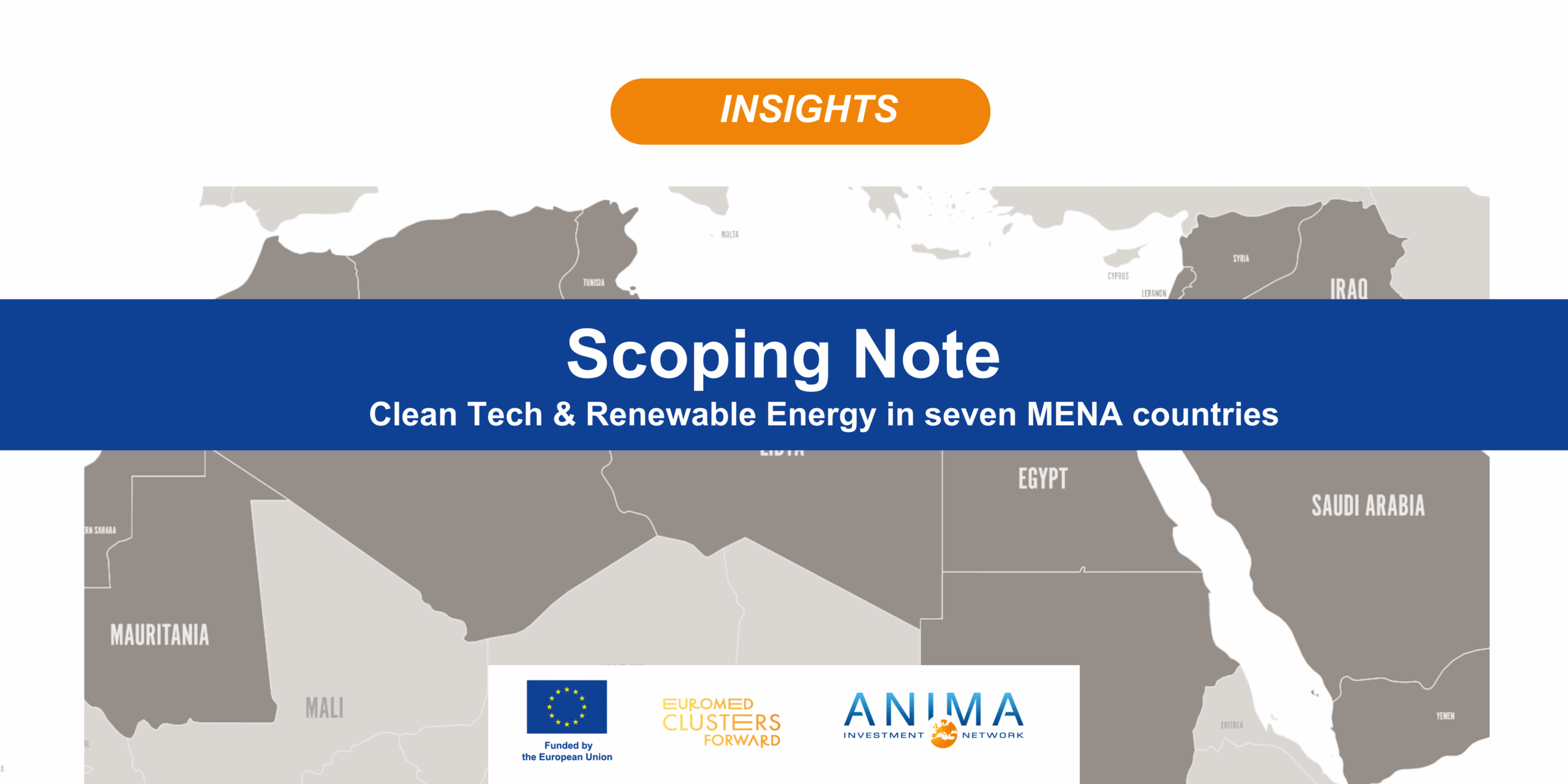
Funded by the European Union and led by ANIMA Investment Network, the Euromed Clusters Forward project targets seven MENA countries: Morocco, Algeria, Tunisia, Egypt, Lebanon, Jordan, and Palestine. With a total budget of €7.7 million (90% EU-funded), the program supports inclusive innovation, enhances cluster competitiveness, and boosts sustainable growth and job creation across the southern Mediterranean.
Transforming Challenges into Opportunities
The economic evolution of Europe and the southern Mediterranean has created a new landscape of shared challenges and mutual opportunities. Cross-border cooperation offers a path to integrated value chains, clean tech development, and regional resilience through sustainable partnerships.
Report Objectives
This report contributes to the European Commission and MENA Directorate General’s strategic reflection on how to unlock the clean energy potential of the Euromed region. It focuses on:
- Mapping Country Positioning in the Clean Tech and Renewable Energy value chains.
- Assessing Sector Potential across green industries.
- Understanding the Role of Clusters in promoting innovation and technology.
- Identifying Ongoing Activities and current clean energy projects.
What is Clean Tech?
Clean Tech encompasses technologies and innovations that reduce environmental impact while enhancing resource efficiency. It includes:
- Renewable Energy (solar, wind, hydro, biomass)
- Waste Management & Recycling
- Energy Efficiency in buildings and industry
- Sustainable Mobility (electric vehicles, hydrogen, smart transport)
- Pollution Control Technologies
Its purpose is to merge sustainability with economic growth, driving competitive yet eco-friendly solutions.
What is Renewable Energy?
Defined by the OECD, renewable energy comes from natural sources that are constantly replenished. This includes:
- Solar
- Wind
- Hydropower
- Geothermal
- Biomass
These sources are essential to achieving carbon neutrality and long-term energy security.
Methodology
This analysis is based on:
- A survey of clusters involved in the Euromed Clusters Forward project.
- Mapping studies conducted under the initiative.
- Desk research and data review from project databases.
Algeria: Solar Giant with Untapped Potential
Algeria boasts 3,000+ hours of sun annually, especially in the south, making it a solar powerhouse. The government targets 15,000 MW of renewable energy by 2035, but over 95% of energy still comes from hydrocarbons.
Progress includes 400–500 MW in solar PV, early wind projects in Tiaret and Adrar, and pilot efforts in green hydrogen and energy efficiency for public buildings.
Key players like CDER and local universities support R&D. Green tech clusters such as GEC’A and CIEL are driving innovation, skills, and clean industry growth—despite regulatory and technical hurdles.
Egypt: Green Ambitions in a Fossil-Fuel Economy
With 117 million people, Egypt’s energy demand is surging. Though natural gas still powers 79% of electricity, Egypt is rapidly scaling up renewables and advancing climate policy.
Major frameworks like Vision 2030, ISES 2035, and the NCCS 2050 guide the transition. The NWFE Program aligns energy with water and food security.
Key Projects:
- Solar: Benban Park (1.8 GW) and 300 MW expansion.
- Wind: 5 GW (AMEA) and 1.1 GW (ACWA) in Suez and Nile Valley.
- Green Hydrogen: Projects in the Suez Canal Zone aim for European export.
Egypt covers the full energy value chain, from PV and turbine manufacturing to installation and services. Still, challenges persist—funding, skills, and green finance policies need strengthening.
Clusters like ERECRI, ECO FEI, and SEDA Egypt are key players in R&D, green industry, and smart tech innovation.
Jordan: Driving Energy Security Through Renewables
With 96% energy import dependence, Jordan prioritizes energy security and local resilience amid regional instability. Renewables make up 74% of domestic energy, mostly solar PV.
JREEF supports clean energy through funding and incentives, while national policies drive efficiency.
Jordan’s strength lies in downstream project implementation, with future upstream growth planned. Clusters like Int@j, INJO 4.0, and Oasis500 promote green tech, digitalization, and inclusive innovation.
Lebanon: Navigating Crisis with Decentralized Green Solutions
Lebanon faces a severe energy crisis marked by fossil fuel dependence, blackouts, and aging infrastructure. This drives urgent demand for decentralized solar, wind, and resilient systems despite economic and political challenges.
Key policies include the NREAP 2024–2030, NEEAP 2021–2025, and the Decentralized Energy Law (2023), promoting clean energy investment and subsidy reform.
Strong activity in the midstream and downstream value chain focuses on:
- Solar PV integration
- Hybrid solar-diesel and battery systems
- Microgrids and energy storage
- Waste-to-energy R&D
Clusters like Berytech Renewable Energy Cluster, EcoSwitch, and QOOT (Lebanon Agrifood Innovation Cluster) drive innovation, while LSS supports green tech digitization. Lebanon seeks stronger EU ties for funding, knowledge, and export-led growth.
Morocco: A Renewable Energy Bridge Between Continents
With abundant sun and wind, Morocco is shifting from 94% energy imports to 52% renewable electricity by 2030. Since 2009, supportive laws have boosted clean energy and private investment.
Key initiatives include:
- IRESEN-led R&D in solar, wind, hydrogen, and agro-energy
- Green Hydrogen Roadmap aiming for 4% of global demand by 2030
- Pilot projects in smart PV and agriculture
Morocco partners closely with the EU and international organizations, offering a full renewable value chain — from resources to grid management. Innovation hubs like Green H2 and CISE lead advances in hydrogen, energy efficiency, and biomass.
Morocco is a stable, forward-looking partner in the Euro-Mediterranean green energy transition.
Palestine: Resilient Renewable Energy Amid Crisis
Despite infrastructure damage from the 2024 Gaza conflict, Palestine continues to advance renewable energy.
With 88% of electricity imported and high costs, solar investment is a priority under national strategies (2020–2030, 2021–2023), promoting private-sector growth and energy autonomy.
Key projects span Hebron, Ramallah, Jericho, and a Jenin gas plant. While downstream gaps persist due to conflict and trade limits, strong solar potential and midstream efforts show promise.
Innovation hubs like PITA, PICTI, Techno Park, and Dates & Palms support green tech and agri-solutions. EU cooperation can boost solar storage, microgrids, and cluster development.
Tunisia: Unlocking Solar Potential Amid Energy Imports
Relying on imports for nearly half its energy, Tunisia leverages strong solar and wind potential to target 35% renewable electricity by 2030. Backed by the TERI Trust Fund, efforts focus on diversification, efficiency, and innovation.
Key projects include the Tozeur Solar Park, Sidi Daoud Wind Farm, and a waste-to-energy unit at Oued Laya. Tunisia leads in deployment, smart energy, and green infrastructure.
Clusters like TuniCree and Borj Cedria Ecopark drive sustainable growth across sectors. EU partnerships offer opportunities in solar, wind, agri-tech, and inclusive green innovation.