


North Africa is emerging as one of the main reservoirs of attractiveness
Published on 07 July 2025

A general trend of deglobalization
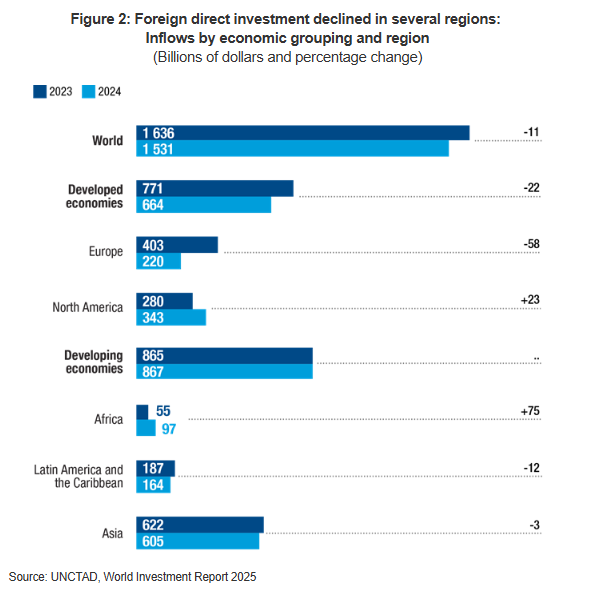
The World Investment Report 2025 published recently by UNCTAD highlights a trend of retreat from globalization. Indeed, even though the global foreign direct investment (FDI) in 2024 increased marginally by 4%, this figure is inflated by volatile financial transactions through several European economies with high levels of conduit flows. Without these, global FDI flows declined by 11% on a like-for-like basis, representing a second consecutive year of double-digit decline.
Except for the United States, FDI is in retreat in the developed economies, as well as in Asia and Latin America.
In this negative performance context, Africa emerged as one of the growth engines for FDI, meanwhile announcements in sectors such as the information and communication technology (ICT), digital economy or manufacturing sectors respectively highly increased and held steady
FDI rebound in Africa mainly driven by North Africa
The report highlights a significant rebound in foreign direct investment (FDI) inflows to Africa. In 2024, foreign investment in the continent shot up by 75%, representing 6% of global FDI compared to a 4% share the year before which exceeds for the first time its share in the global GDP. In parallel, investment facilitation efforts continued to feature prominently in Africa, accounting for 36% of policy measures favourable to investors.
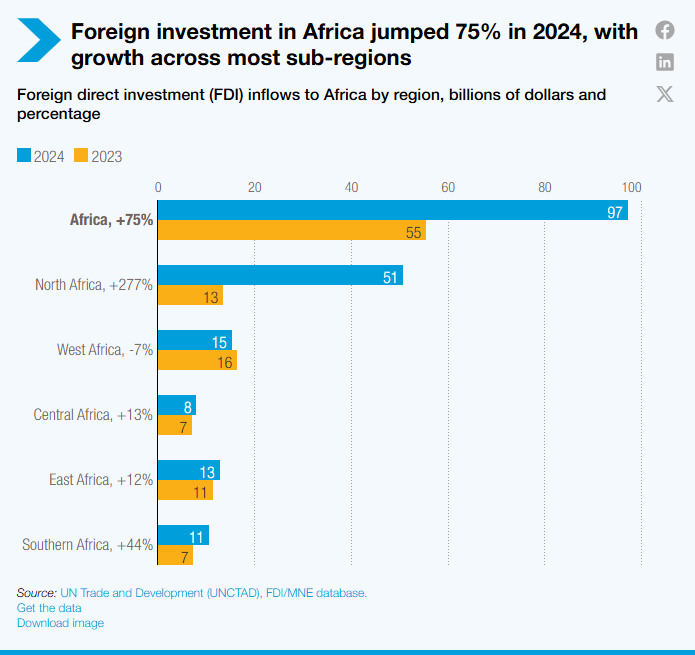
Within the continent, North Africa led this increase with a 277% growth over one year.
If Egypt has been the driver of this growth, with a rise from $9.8 billion to 45.6 billion in one year, all countries in North Africa have shown a remarkable performance: Algeria rose by 18% to $ 1.2 billion FDI, Tunisia by 21% to $936 million and FDI in Morocco increased by 55% to $1.6 billion.
Most importantly, greenfield project (new projects) in North Africa values increased by 12% to reach $76 billion, accounting for two thirds of total project capital expenditures on the continent. If Egypt benefitted notably from a single $35 billion megaproject in Ras ElHekma (UAE-Egypt joint venture), Tunisia contributed significantly, with greenfield investment announcements worth $13 billion (from close to zero in 2023) and a significant rise in project numbers.
Greenfields driven by energy and infrastructure
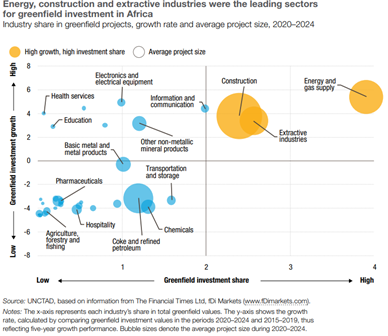
In 2024, the energy sector stood out as the top one for greenfield activity. The renewable energy industry recorded substantial growth in both the number and the value of projects. Egypt, Tunisia and Morocco emerged as the primary destinations for renewable energy projects. Although investment needs in energy security remain vast, the growth trend underscores the important role of FDI in improving energy supply across Africa and in supporting the gradual shift in Africa towards a more sustainable energy future.
Globally, the construction sector represented nearly 10% of total greenfield project value in the African continent. Extractive industries also recorded strong growth, with project numbers and total investment value rising by about one third. These developments reflect, among other factors, a structural shift within the energy and resources sectors in Africa. While investment in extractive industries for critical minerals and in renewable energy projects is growing, FDI in fossil fuel processing is in decline.
Although still modest in overall share, the digital economy has emerged as one of the fastest growing sectors – expanding by more than three quarters in project value and by nearly one third in project numbers over the last five years.
The emergence of a regional integration
The United Arab Emirates have established as the main providers of foreign direct investment in North Africa, representing more than 40% of FDI amounts, ahead of Europe (in particular France, UK, Germany and Poland), Asia (South Korea and China) and North America (Canada and US).
These figures contradict preconceived ideas that European involvement is declining in favour of China. While Chinese investors have been very active in recent years in analysing investment opportunities in North Africa, it seems that they have not yet taken action to the extent that might be expected. On the other hand, the commitment of the Emirates to the urban and energy transition, supported by their ability to take part in mega-projects, and the loyalty of European investors to this region, where they have long been the leading investors, seem to point to the beginnings of growing integration within the EMEA region.
If you would like to learn more, you can read the full report of World Investment 2025.